

Regulation Is Not Liberation: The Limits of Individualized Trauma Care and the Case for Co-Capacity

I was browsing YouTube when I was baited into clicking on a Thomas DeLauer video with an inflammatory title: “They Were WRONG About Therapy. This Stops Anxiety and PTSD in its Tracks.”
In the interview, forensic neuropsychiatrist Jeffrey Rouse argues that trauma produces excessive sympathetic nervous system activation that leads to overgeneralized threat learning and poor integration of traumatic memory into narrative memory networks. PTSD emerges when this process becomes self-reinforcing and fear extinction is impaired. He emphasizes that therapeutic recall must occur in a physiologically regulated and relationally safe context so that memories can be reconsolidated with reduced affect.
ShiftWave Pro is presented as a neuromodulation tool designed to downregulate autonomic arousal, thereby removing physiological barriers to neuroplasticity during psychotherapeutic reintegration rather than directly treating trauma on its own.
“We… had some people donate our systems to Ukraine… to a camp in the Carpathian mountains… for children who had lost one or both parents during the Russian invasion. In most of those cases, the children were actually physically present when that happened… We had the pleasure of going to that camp and observing what they were doing. It was super duper smart. They had a psychologist design the camp’s daily activities… play, sharing, [and] crossbody activities to introduce more neuroplasticity…
They would go in our chair and then they would do psychotherapy afterwards. [The] Ukrainian psychologist… then saw that children were actually for the first time opening up and talking about the actual trauma… they felt internally safe enough to discuss that trauma… Children are incredibly, incredibly resilient. We all know that. But to really bring out that resilience… demands an intentionally constructed approach. It’s multimodal. It’s not just a neuro-chair. It’s connection. It’s exposure. It’s psychotherapy. It’s play. It’s expression. It’s hugs.
It’s the opportunity to, like, not just be a kid who lost both their parents a week ago, but also to be a kid.” — Jeffrey Rouse
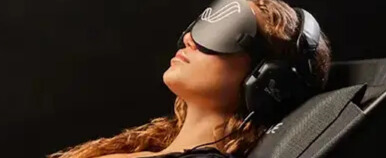
His work aligns with my claim that short-term co-regulation assists in making the transition from collapse to agency-expansion regimes. He does not, however, address the risks of enhancing neuroplasticity in circumstances where agency is not yet available.
Used incorrectly, this device becomes another psychiatric tool of subjugation. If we increase plasticity without increasing option-space, we may only learn to endure injustice instead of rightly refusing it. In time, would feeling happy and peaceful while living in a warzone or a capitalist hellscape lead to a mismatch between p_social (one’s legibility and agency within a social field) and p_self (one’s internal legibility of their agency)? Internal legibility rises while external legibility stagnates. Compliance is optimized.
When regulation is treated as an endpoint rather than a bridge, we may reduce PTSD risk at the cost of reinforcing objecthood — a state of internalized domination produced under coercion, where we are legible only as a function to the system, while our internal authorship is left to decay in the dark. Regulation can reduce arousal too early — before meaning is self-authored — which makes whatever interpretation is most compatible with the existing conditions feel true.
Intuition, Stress, and Patriarchy’s Epistemology
Regulation is already weaponized in closed arenas such as prisons and schools to enforce control over the population. In a non-revisable system, the plastic nervous system learns comfort with emotional self-suppression, boundary blunting, premature acceptance, and false reconciliation. This is domestication, not resilience.
Our stress and our anger are information, not personal failure. It’s the system picking up on risk, coercion, or misalignment before the brain has a clean narrative for it. Intuition is valuable because it’s lived pattern recognition, and patriarchy devalues it by labeling it emotional or irrational especially when it challenges power.
Rouse argues that the chair allows the Ukrainian child to feel “internally safe.” In the Carpathian camp, this internal safety matches the direct external reality, even if the world outside remains violent. But what happens when we use that same ‘reset’ on a sex worker whose external reality remains a predatory legal and economic system? We are creating a false internal signal that hasn’t ‘cured’ PTSD; it has disabled the alarm system required for survival.
A psychology oriented toward liberation must treat regulation as a transitional state, not a therapeutic endpoint. But a transition is not automatically liberation either. The political question is always transition to what.Its task is not merely to soothe dysregulated nervous systems, but to improve co-capacity: durable, shared abilities to act, decide, and repair within the environments people actually inhabit. Regulation is precious when it helps someone regain enough stability to pursue safety, boundaries, and collective power.
Yet tools like ShiftWave Pro — priced at $10,000 each — promote the opposite. They encourage the individualization of regulation rather than the transformation of environments.
In real life, we don’t climb into a neuromodulation chair before telling the truth. We tell the truth while still activated, inside the very relationships and systems that shape what can be said. A device that trains regulation as a private prerequisite can model an unrealistic — and politically convenient — sequence: stabilize yourself first, then re-enter unchanged conditions.
Two Versions of Group Therapy:
From Co-Regulation to Co-Capacity
Envision group therapy as we know it now: people sitting a bit awkwardly in their chairs, sharing stories of stress and sadness, naming the systems that wear them down, and then going home to the same circumstances they complained about.
Now, consider group therapy as a site of practicing and building co-capacity: the group once again shares their fears and sorrows, but then considers their goals and constraints. They discuss their ability to contribute and negotiate how deeply invested the group must be to succeed, and in time, they build. This is not healing as adjustment, but repair as mutual aid in motion.
In the compliance model, the goal is to stay within the window of tolerance so you can continue to function within an oppressive system. If the system pushes you out of your window, you use a device to pull yourself back in. In the liberation model, relational and material support from the group lowers your baseline autonomic arousal, shifting your stress thresholds so that previously overwhelming stimuli become more manageable — not through individual effort alone, but through shared regulation that distributes threat across a collective nervous system.
As a sex worker, I’ve had reservations about mutual aid. It seemed unfair to contribute to groups that can’t protect me. The price of my contribution might be $50, but that obscures my compounding risk of losing housing or my bank account, going to jail, losing friends and partners and my civilian work reputation, being deplatformed, being targeted when vulnerable, or being stalked or raped or risking death and disease. When this risk comes due, it will cost thousands in comparison to my monetary contribution of $50. A truly reciprocal network needs to factor in the cost of my labor.
Within the concept of group therapy, if we put a sex worker, drug dealer, or other criminalized worker in a group with civilians, the civilians might be unable to pay for the legal fees that eventually come due.
Aside from external funding, the smaller groups should therefore also contribute to an overall fund of all the groups to protect the most vulnerable in each. If a group cannot underwrite the risk of its most vulnerable members, it is not a site of repair; it is only a support group with a high barrier to entry.
The civilians in the group are paying into a system that acknowledges their own relative safety is a resource that should be redistributed to protect the “nerve endings” of the movement — those most exposed to the state. We should not isolate people based on stigma or the state’s domination. To the brain, being alone reflects a state of emergency. This re-integration to society would itself be a form of repair.
In this context, a legal defense fund is more than a financial safety net; it is a form of collective neurological regulation. If the sympathetic nervous system triggers when a threat outweighs our capacity to meet it, then the pooling of resources is a direct intervention into the brain’s threat-detection logic. We often think of regulation as something that happens inside the skin — deep breathing or neuromodulation — but for the criminalized, regulation is material support and redistributed safety.
Knowing that bail is covered or that a community will fight a deplatforming doesn’t just soothe the nervous system with a false signal; it physically lowers the cost of the threat. This is material vagal tone: the group acting as an external nervous system that absorbs the shock so the individual doesn’t have to. Emotional regulation can be useful for managing immediate distress, but for criminalized and vulnerable communities, regulation must extend beyond the internal. It requires material support and collective capacity to shift the actual landscape of threat. We need to be externally protected so our internal signals remain sharp, honest, and ready to refuse.
As this would be group therapy, and therefore legible to the state, the form of the group must adapt in time. I’m suggesting that, originally, it should be a time-bound scaffolding to learn relationship skills for care and building agency together. The group decides their own goals and investment depth, surveyed on their variables and end result but with no requirement to hit a metric. If, after the period passes, the members choose to continue supporting one another, that is their own choice.
This isn’t about building an organization. It’s about building the ability to organize.
If a group picks an unachievable goal, such as increasing agency without increasing material stability or some other incompatible combination, they can attempt it, but they should be able to review why it didn’t work at the end so they feel optimistic about possibly revising and trying again. It is not a failure, but a hypothesis that didn’t pan out. Learned helplessness happens when effort fails and is punished. But if we instead produce information and make constraints visible, it would just make sense.
That’s not to say that neuromodulation devices are entirely useless. Regulation matters. But liberation requires that regulation point somewhere real: material safety, enforceable boundaries, and collective capacity. Our aims must always focus on agency and subjectivity. Otherwise, we are only optimizing our own domestication within a system that refuses to change.
♥︎

Notes:
The “liberation model” language here is influenced by liberation psychology (especially Ignacio Martín-Baró) and critical pedagogy (Paulo Freire), which treat psychological suffering as socially produced and healing as a collective process. Any extensions or errors here are my own.
While individual psychology allows us to tend our own internal garden, we must recognize that every garden is part of a larger field. No amount of personal weeding can save a harvest if the soil itself is being salted by the state.
One response to “Regulation Is Not Liberation: The Limits of Individualized Trauma Care and the Case for Co-Capacity”
-
When I read about the “window of tolerance” I felt that my experience at the recovery centers I have been to do exactly what you said, just make us domesticated to a society that is not of our choosing. This is really well written and I will be testing it again. I have had a lot of vagal nerve work along with somatic. I have also been in several other neurological regulation programs. Thank you for your insights. Your writing is important.
I have great empathy for the sex worker industry, the same people that use and abuse sex workers are among the same people writing and supporting legislation against sex workers.

About Me

𖹭 Aeris 🏴
Hello. 𖹭
This blog is more of an exploration than a statement.
Thinking in public; staring at the stars.
I’m dreaming of a better world.
Follow Me
𖹭 for work unrelated to this blog
Leave a Reply