
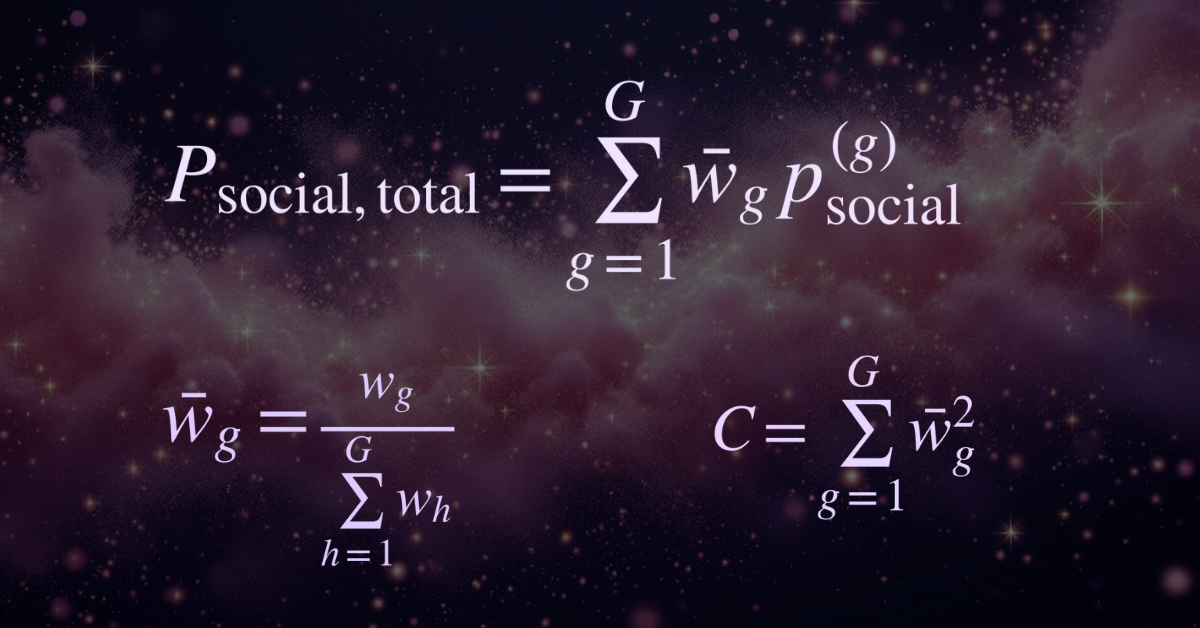
Working Log v0.5 Change: P_social Formula, Weighted, Concentration

The equations above are my rough draft and may change in time. I also have not yet determined how weight or perception should be measured.
First, let’s disambiguate these terms: Agency (A), Subjectivity (U), Perceived Self (p_self), Perceived Social Field (p_social), and Reflexivity (X).
1. Agency
What it is:
The capacity to act, choose, refuse, initiate, and alter trajectories in the world.
Key question it answers:
Can something happen because of me?
Agency is about causal force. It exists even when it is constrained, coerced, or punished. Agency can be overridden, redirected, or made costly, but it is not the same thing as freedom.
2. Subjectivity
What it is:
The lived, first-person experience of being a someone rather than a something.
Key question it answers:
Is there an “I” here whose experience matters?
Subjectivity is about phenomenological presence: having feelings, meanings, interpretations, values, and inner texture. It includes pain, desire, dignity, confusion, pleasure, and interpretation.
Critical note:
Subjectivity can exist without agency being respected. This is why humiliation, gaslighting, and objectification are injuries. They don’t just block action; they deny the legitimacy of experience.
3. p_self (internal agency legibility)
What it is:
How legible your own agency is to yourself.
Key question it answers:
Can I perceive myself as a chooser, an actor, a refuser?
p_self is not agency itself. It is your internal model of your agency.
Low p_self looks like:
- “I don’t know what I want.”
- “Nothing I do matters.”
- “I guess this just happens to me.”
- Reflexive compliance without felt choice.
High p_self looks like:
- Awareness of options (even bad ones).
- Sense of authorship over actions.
- Ability to name preferences and refusals.
- Ownership of decisions even under constraint.
Key insight:
Domination often targets p_self first. If you can’t see your agency, it doesn’t matter that you technically have it.
4. p_social (social agency legibility)
What it is:
How legible and recognized your agency is to others and to systems.
Key question it answers:
Do others treat me as someone whose choices count?
p_social is about recognition, not internal experience.
Low p_social looks like:
- Being ignored, overridden, infantilized.
- Others acting “for your own good.”
- Decisions being made about you without you.
- Your refusals being reframed as confusion or pathology.
High p_social looks like:
- Your consent matters.
- Your refusals change outcomes.
- You are consulted, negotiated with.
- Systems adapt when you push back.
Crucial asymmetry:
You can have high p_self and low p_social (clear inner agency, socially denied).
You can also have high p_social and low p_self (others defer to you, but you feel hollow or compulsive).
5. Reflexivity
What it is:
The capacity to inspect, revise, and reconfigure one’s own internal models of agency, subjectivity, and choice.
Key question it answers:
Can I notice how I’m choosing, not just choose?
Reflexivity is meta-agency. It lets you:
- Notice when fear is steering.
- Identify lock-in and hysteresis (τ).
- Ask “Is this actually my value or a survival adaptation?”
- Update p_self when it’s distorted.
- Re-negotiate relational patterns.
Important boundary:
Reflexivity is not infinite freedom. Trauma, threat, and exhaustion all reduce it. But when present, it allows repair instead of repetition.
How p_self and p_social Interact
The relationship between p_self and p_social appears to be that when p_social persistently fails to reflect or tolerate p_self, the agent must either suppress, fragment, or disguise their own choosing, which produces internalized domination and/or subjectivity decay. That is because in those conditions, expressing p_self is punished, while suppressing p_self leads to belonging.
When the internal capacity to represent choice and generate options is itself degraded, repair is typically slower and more complex than when preferences remain legible but suppressed, because the work involves rebuilding representational infrastructure rather than lifting constraints.
When social recognition of agency increases in a way that preserves internal authorship and allows revision, inner experience becomes a reliable guide rather than a liability; over time this feedback loop stabilizes and thickens subjectivity.
A small example of increasing p_social is a community garden that allows revision and safe addition: when a new person arrives, they’re free to plant their own flower alongside others, contributing to shared meaning without needing to conform or justify their presence.
From an institutional design perspective, maximizing p_social within a single domain is not desirable, because concentrated recognition tends to dominate meaning rather than support it. High p_social in a high-weight field can still increase vulnerability rather than safety when revisability or exit is constrained.
Subjectivity is fragile because it depends on social conditions that can be disrupted far more quickly than they can be repaired. Recognition, contestability, and revisability can disappear when a single institution is captured, while rebuilding them requires sustained relational coherence over time. Distributing p_social across parallel institutions mitigates this fragility: one normative implication is that exodus strategies prevent any one social field from monopolizing agency legibility, preserving p_self by ensuring that the loss of recognition in one domain does not collapse the individual’s capacity to perceive themselves as an author of choice.
p_social, total Formula
This is a working formalization, not a settled model.
I’m considering the value of p_social to be between -1 to 1, where:
-1 is false p_social (the social field rewards suppression, disguise, or domination),
0 is neutral,
and 1 means the social field reflects and supports p_self.
The weighted structure of the formula is intentional. Subjectivity does not arise from a single site of recognition, but from the interaction of multiple social fields with unequal relevance.
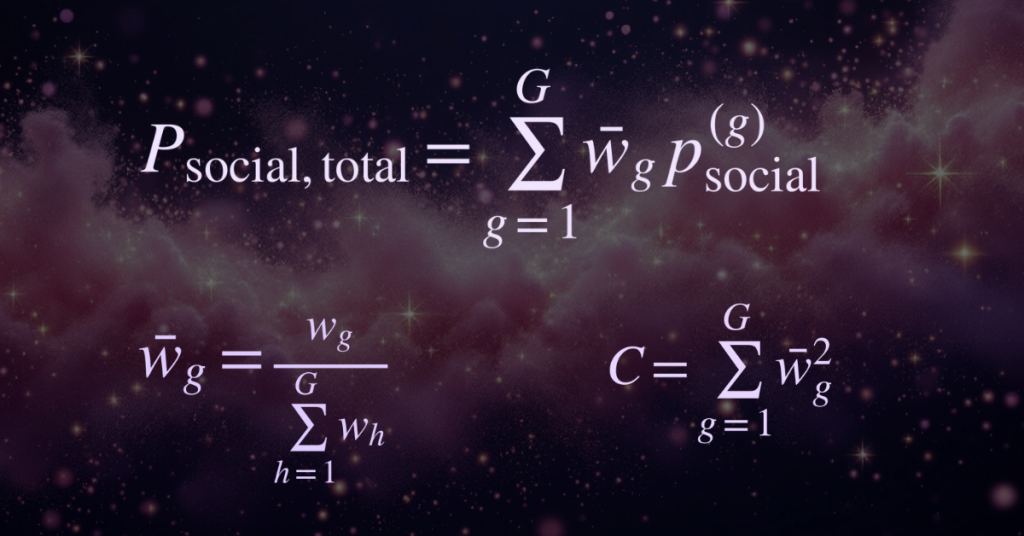
To make it easier to read: w is weight, g is group, and C is concentration. h is not a new variable, but is an index name meaning “add up all the weights across all fields.”
Let’s consider an example scenario where someone has: a high stakes job, a medium-enmeshed family, and a pleasant but low-importance garden club.
Determining weight using arbitrary but intuitive values:
w-job = 9
w-family = 3
w-garden club = 1
w-total = 9 + 3 + 1 = 13, making w-job weighted at 0.692, w-family at 0.231, and w-garden at 0.077.
The job is somewhat misaligned/coercive, family is mixed but somewhat supportive, and the garden club is very warm and supportive.
p_social-job = -0.4
p_social-family = +0.2
p_social-garden club = +0.9
I’m giggling to myself because why did I make the garden club the best part of this example-person’s life? Anyway…
Therefore:
p_social,total = (0.692)(−0.4)+(0.231)(0.2)+(0.077)(0.9)
p_social,total ≈ −0.277+0.046+0.069 = −0.162
So the overall social climate comes out net negative mainly because the job has so much weight that even a very nice garden club can’t “outvote” it.
Using the concentration formula, we can get an easy gauge of whether any of these groups are taking a dangerous share of life-stakes.
C=(0.692)2+(0.231)2+(0.077)2
C=0.470 + 0.053 + 0.006 = 0.538
What does C = 0.538 mean intuitively? If one field totally dominates, C = 1. If weights are perfectly even between the three groups, C = 0.333. So, 0.538 being closer to 1 does indicate one of the fields is an issue.
It becomes clearer here:
N-effective = 1/C = 1/0.538 = 1.86.
That means that although there are three groups, the stakes distribution behaves like there are only 1.9 equally-weighted pillars. The job is so heavily weighted that the social world isn’t really plural in the way “three groups” would be on paper.
C only measures how concentrated your dependence is, not whether those fields are supportive. p_social,total is still needed to demonstrate alignment.
What happens when the gardening club becomes a serious pillar of life, though?
w-job = 0.45
w-family = 0.15
w-garden club = 0.40
C = 0.452+0.152+0.402 = 0.2025+0.0225+0.16 = 0.385
N-effective = 1/0.385 ≈ 2.60
While 2.60 isn’t perfect, it’s clearly much better than 1.86. It’s closer to two pillars plus a smaller one instead of one group engulfing the others.
And now to go find my local gardening club…
♥︎

About Me

𖹭 Aeris 🏴
Hello. 𖹭
This blog is more of an exploration than a statement.
Thinking in public; staring at the stars.
I’m dreaming of a better world.
Follow Me
𖹭 for work unrelated to this blog
Leave a Reply