
Could We Both Be the Oxen? Debt, Agency, and Care

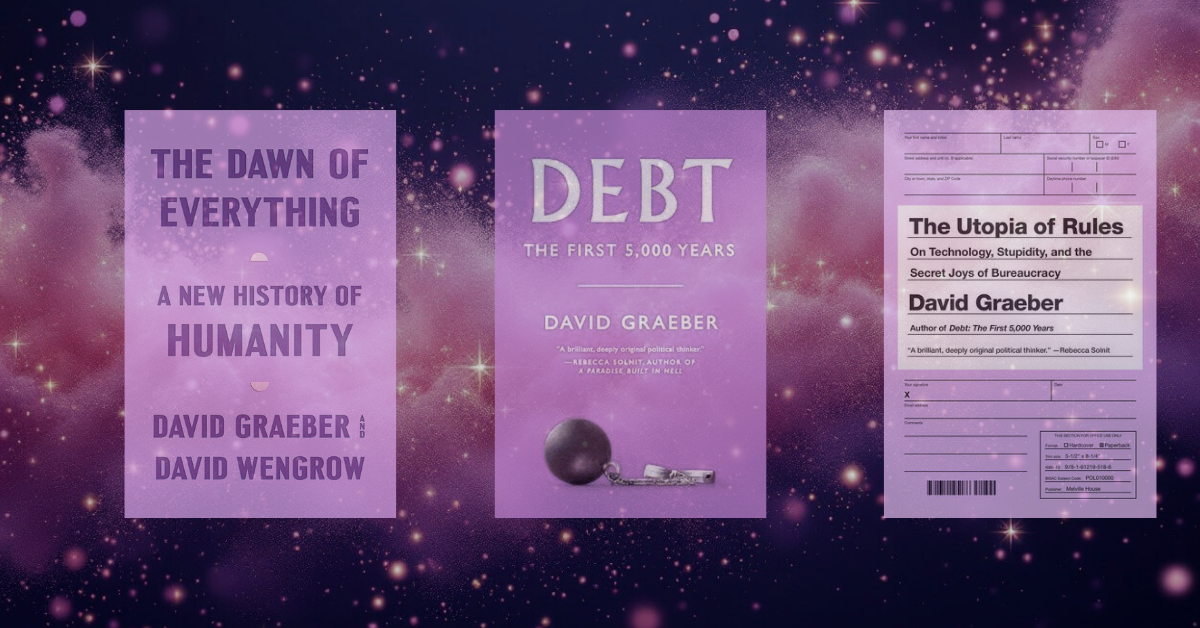
Since I’d been thinking about Graeber earlier, I opened Debt again. There was a parable that struck me as unusual this time. I’m quoting it at length because there’s a contradiction within the passage that I don’t think survives excerpting:
Other religious traditions have different perspectives. In medieval Hindu law codes, not only were interest-bearing loans permissible (the main stipulation was that interest should never exceed principal), but it was often emphasized that a debtor who did not pay would be reborn as a slave in the household of his creditor—or in later codes, reborn as his horse or ox. The same tolerant attitude toward lenders, and warnings of karmic revenge against borrowers, reappear in many strands of Buddhism. Even so, the moment that usurers were thought to go too far, exactly the same sort of stories as found in Europe would start appearing. A Medieval Japanese author recounts one—he insists it’s a true story—about the terrifying fate of Hiromushime, the wife of a wealthy district governor around 776 AD. An exceptionally greedy woman,
she would add water to the rice wine she sold and make a huge profit on such diluted saké. On the day she loaned something to someone she would use a small measuring cup, but on the day of collection she used a large one. When lending rice her scale registered small portions, but when she received payment it was in large amounts. The interest that she forcibly collected was tremendous—often as much as ten or even one hundred times the amount of the original loan. She was rigid about collecting debts, showing no mercy whatsoever. Because of this, many people were thrown into a state of anxiety; they abandoned their households to get away from her and took to wandering in other provinces.
After she died, for seven days, monks prayed over her sealed coffin. On the seventh, her body mysteriously sprang to life:
Those who came to look at her encountered an indescribable stench. From the waist up she had already become an ox with four-inch horns protruding from her forehead. Her two hands had become the hooves of an ox, her nails were now cracked so that they resembled an ox hoof’s instep. From the waist down, however, her body was that of a human. She disliked rice and preferred to eat grass. Her manner of eating was rumination. Naked, she would lie in her own excrement.
Gawkers descended. Guilty and ashamed, the family made desperate attempts to buy forgiveness, canceling all debts owed to them by anybody, donating much of their wealth to religious establishments. Finally, mercifully, the monster died.
The author, himself a monk, felt that the story represented a clear case of premature reincarnation—the woman was being punished by the law of karma for her violations of “what is both reasonable and right.” His problem was that Buddhist scriptures, insofar as they explicitly weighed in on the matter, didn’t provide a precedent. Normally, it was debtors who were supposed to be reborn as oxen, not creditors. As a result, when it came time to explain the moral of the story, his exposition grew decidedly confusing:
It is as one sutra says: “When we do not repay the things that we have borrowed, our payment becomes that of being reborn as a horse or ox.” “The debtor is like a slave, the creditor is like a master.” Or again: “a debtor is a pheasant and his creditor a hawk.” If you are in a situation of having granted a loan, do not put unreasonable pressure on your debtor for repayment. If you do, you will be reborn as a horse or an ox and be put to work for him who was in debt to you, and then you will repay many times over.
So which will it be? They can’t both end up as animals in each other’s barns.
I understand that Graeber’s intention here wasn’t to actually answer the question, but to express how debt morality forces one to carry moral fault and confusion. That said, I think it makes perfect sense how both the creditor and debtor could end up reborn in each other’s barns. What changes if we read this parable not as moral accounting, but as a problem of agency?
It feels natural that a debtor would feel a sense of intense obligation to the creditor. If the debt isn’t repaid, the creditor has been limited by the debtor: resources they were counting on to survive, room to maneuver, and sometimes pressure toward defensive behavior or enforcement mechanisms they might otherwise reject. If a debt is enforced, the debtor loses capacity through survival pressure, narrowed options, and threat. The ability to act is reduced for both parties. Not equally, but jointly.
By showing that the dominating party is also constrained and degraded by the arrangement, the parable opens a personal path to voluntary surrender — not as punishment, but as a human step toward mutual repair and collaborative accountability.
None of this is an argument against interdependence. The uneven “debts” we owe one another keep us connected and warmly embraced in community. As Graeber implies, in a relational sense, debt is simply time: a shared understanding that balance does not need to be restored immediately, because the relationship itself is expected to continue.
Enforcement does not restore order when it degrades agentic capacity on both sides. In those cases, debt stops coordinating interdependence and instead manages threat badly, disguising that failure as justice.
When does a claim lose its right to override survival? There seem to be (at least) three different things that get conflated under “debt”:
✧ Open-ended reciprocal obligation
“I help you, you help me later”
(human-scaled, flexible, contextual, something like neighborhood care)
✧ Bounded contractual exchange
“I lend you X, you repay Y”
(still conditional, still contextual)
✧ Extractive claim
“I own a right to income regardless of need or origin”
(rents, interest, enclosure, monopoly)
So, yes, it makes sense that people feel obligated because the first category, reciprocal obligation, is very natural. This is one reason why obligation reliably appears. What was a good thing has only become corrupted by severely asymmetric relationships and forms of domination that strip it of meaning.
If a claim originates in extraction rather than contribution — things like economic rents, enclosure, or the stealing of workers’ surplus labor value — its moral force is already thin. In those cases, repayment no longer reflects interdependence, but the enforcement of a prior claim that constrains someone else’s future capacity to act.
To owe someone something is not a failure; it’s often the beginning of care. Debt only carries a “sinful shadow” because we’ve learned to fear what happens when dependence is captured by domination. If we can separate reliance from dominance and release our shame, we can recover obligation as something warm and precious: a promise that imbalance does not mean abandonment. Sometimes, that begins by asking a simple question: Could we both be the oxen here?
✩‧₊˚─────⋆⋅☆⋅⋆─────˚₊‧✩‧₊˚─────⋆⋅☆⋅⋆─────˚₊‧✩‧₊˚─────⋆⋅☆⋅⋆─────˚₊‧✩
Footnotes:
Debt enforcement doesn’t just constrain resources; it captures gain (g), biasing the system toward dependency and hysteresis and making a return to an “Agency Intact” regime structurally difficult by pre-structuring future action around satisfying the creditor’s claim.
In a fully extractive system:
The debtor-as-ox
✧ Forced into reactive labor
✧ Actions pre-committed to survival and repayment
✧ No slack to explore alternatives
✧ Persistently elevated gain, little opportunity for recovery
The creditor-as-ox
✧ Dependent on continued extraction to maintain position
✧ Locked into enforcement and monitoring
✧ Unable to relax extraction without destabilizing the system
✧ Likewise loses freedom to act differently
Result:
✧ Both parties are locked into roles
✧ Behavior becomes repetitive rather than adaptive
✧ Strategic reorientation becomes increasingly difficult
Just as an ox can only walk in a circle to turn the mill, an extractive economy can only produce “repayment.” It cannot produce art, innovation, or repair.

One response to “Could We Both Be the Oxen? Debt, Agency, and Care”
-
[…] Recursive Alienation: A dynamic in which systems of domination not only constrain those subjected to them, but also mediate and partially estrange the agency of those who enact them, as their actions are routed through abstract structures that weaken direct authorship and feedback.This is a structural-causal claim, not a claim about individual personality. Psychological patterns in dominators theorize how weakened authorship and feedback manifest within individuals; the structural condition is what produces those patterns, not what they are.The concept names why domination self-reinforces and points to where possible leverage points for repair lie. It accounts for how domination becomes livable for those who enact it, and why the suffering it produces is asymmetrical but mutual. (“We are both the oxen here.”) […]
About Me

𖹭 Aeris 🏴
Hello. 𖹭
This blog is more of an exploration than a statement.
Thinking in public; staring at the stars.
I’m dreaming of a better world.
Follow Me
𖹭 for work unrelated to this blog
Leave a Reply