

Working Log v0.3. Change: Asymmetry, Hysteresis, Repair

Something that’s become unavoidable as I keep refining this model is that the system is not symmetric. I’ve been describing a feedback loop, but collapse and recovery don’t follow the same dynamics.
The key shift is separating vigilance from sensitivity. Vigilance, V(t), is a fast state variable (moment-to-moment arousal). Sensitivity or gain, g(t), is a slow, learned parameter that determines how strongly threat and safety signals are weighted.
Under chronic threat, gain increases quickly. When threat is removed, gain does not automatically decrease. Vigilance inputs are reduced, but the system still reacts strongly because the weighting remains high. In other words, removing threat stops further damage but does not undo prior learning.
♥︎ This implies hysteresis: the path into dysfunction is not the inverse of the path out.
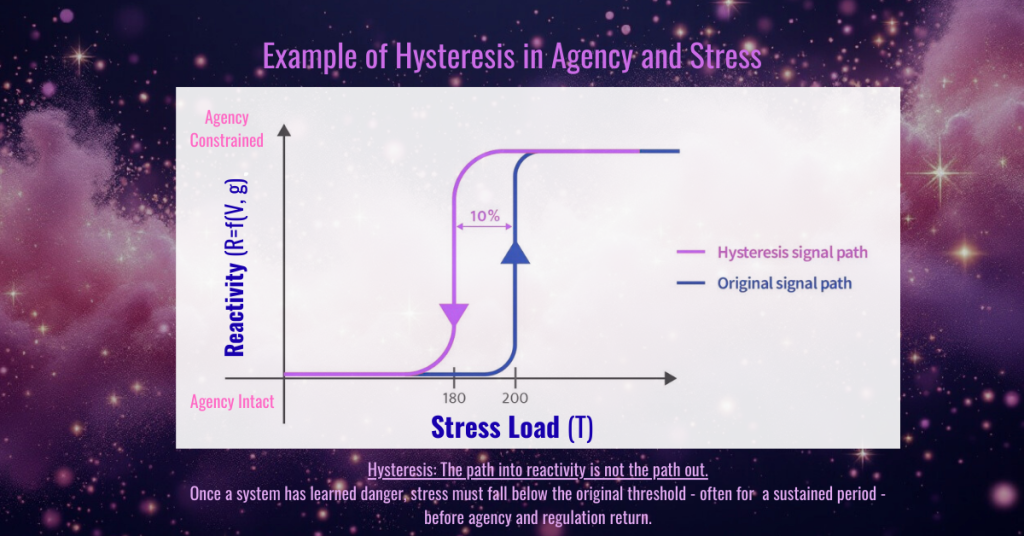
Threat, vigilance, and gain are not what agency is made of. They are how many upstream factors get collapsed into control parameters that determine whether agency is available.
This also clarifies why the “agency expansion loop” only exists in one regime. Below a minimum agency threshold, dynamics are dominated by threat learning and dissipative stabilization. Cooperation fails and no reinforcing loop operates. Above that threshold, cooperation becomes reliable enough to act as an endogenous stabilizer, reducing effective threat and allowing agency to expand recursively.
Repair enters here not as a variable but as a condition for plasticity. Without repair, gain remains effectively frozen and buffering only prevents spikes. With repair, corrective signals are trusted and sensitivity can slowly recalibrate.
So the loop is real, but asymmetric: collapse is largely one-way due to hysteresis; expansion is the reinforcing behavior that becomes available only after sufficient restoration. An exception occurs under targeted state threat, where the same feedback structure inverts into a predation loop.
Next step: formalizing and clarifying what kinds of interventions actually allow g(t) to decrease.
Finally, this framing suggests that a single-agent model is incomplete. Co-regulation and repair are inherently relational, which implies some form of coupling between agents — most plausibly acting on gain dynamics. I’m flagging this as a future extension rather than developing it here.
Time for yet another sleep!!! 𑣲𝑨

2 responses to “Working Log v0.3. Change: Asymmetry, Hysteresis, Repair”
-
Oversharing here, but my mum and my brother used to argue a lot and slamming doors was very common. Even though my brother has long moved out, any time a door slams my shoulders get tense, even to this day. So yes, the threat has long been gone, but my learnt reaction remains.
-
Thank you for trusting me with that. I’m really sorry you grew up in an environment like that. It makes complete sense that your body would still react, even now.
Nothing is “wrong” with you there. It’s a learned protection that hasn’t yet been given enough evidence that it’s safe to let go. I appreciate you sharing something that personal. 🩷
-


About Me

𖹭 Aeris 🏴
Hello. 𖹭
This blog is more of an exploration than a statement.
Thinking in public; staring at the stars.
I’m dreaming of a better world.
Follow Me
𖹭 for work unrelated to this blog
Leave a Reply