

Working Log v0.4. Change: The Shape of “Nothing”

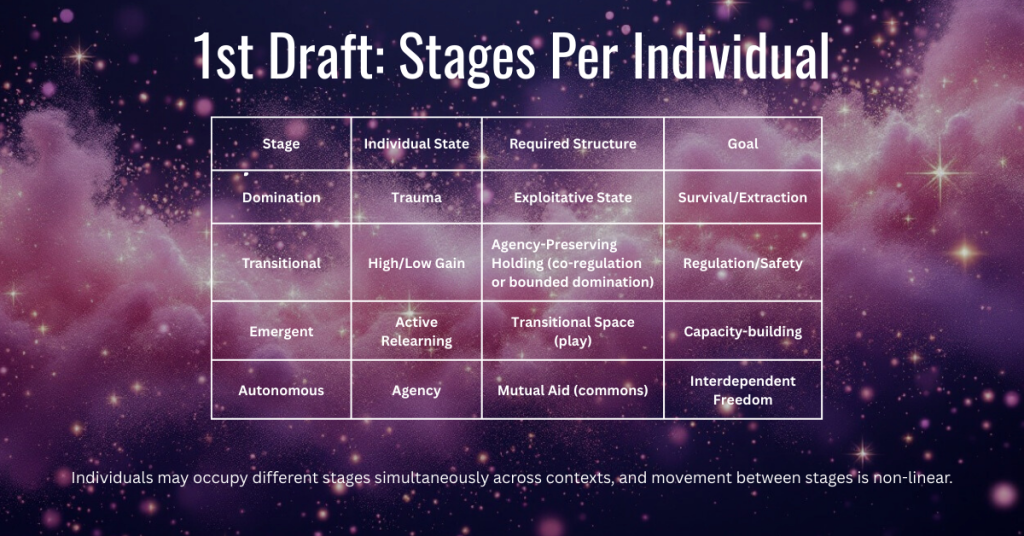
I’d been devaluing the role of “nothing happening over time” because “nothing” didn’t help me recover from my PTSD symptoms. For what I’ve achieved, active relearning did. So when some anarchists get overly optimistic about the end of domination leading to greater things, I sighed and dismissed them as missing the point.
But. I’ll admit I was wrong. Those people are wrong too, but we’re both wrong: “Nothing” has its own topology.
A. To me, “nothing” does slowly erode gain but does not on its own reopen agency.
Yet, without “nothing,” I may have found change to be deprioritized, suspicious, or unachievable, so it played a role as a precursor.
B. To someone else, I realized, post-threat “nothing” may actively feel like anxiety. When a system is organized around managing uncertainty, lack of signal becomes a threatening gap that raises gain. In those conditions, a sense of control is maintained through vigilance and action rather than rest, and bounded structure is often required before “nothing” can begin to feel safe or trustworthy. As I’ve said in my previous post on “Agency-Preserving Domination,” some forms of domination might help people feel freer within a certain consensual timeframe.
Considering that, I feel a vague sense that Type A may overlap with patterns described in dissociative PTSD, while Type B may overlap with fawn-dominant regulation PTSD subtype. Would a flight-dominant person experience nothing as a threat to their identity, as their agency may be tied to momentum? Would a fight-dominant person experience nothing as grating?
One additional complication is that dissociative regulation may involve low apparent gain rather than high reactivity; while this can reduce distress after threat removal, it can also inhibit active relearning by dampening salience and engagement.
Relational trauma also requires relational repair. While we can work to increase safety with environmental cues, the question of how to achieve agency-preserving dominance without becoming dominating — and without bureaucratic sprawl — remains a question to me.
I’m not afraid to research and incorporate dense clinical literature, but I need to consider in what ways this is valuable or inapplicable to my overall goal. After all, my goal isn’t to improve anarchist literature but to build actual spaces for real humans to engage with.
For now, I acknowledge that post-threat nothing has a shape, that shape can feel like a threat, and each will require different interventions to feel safe in the world.
Need to read/re-read: Stephen Porges, Pete Walker, Donald Winnicott, Wilfred Bion, Nora Bateson

About Me

𖹭 Aeris 🏴
Hello. 𖹭
This blog is more of an exploration than a statement.
Thinking in public; staring at the stars.
I’m dreaming of a better world.
Follow Me
𖹭 for work unrelated to this blog
Leave a Reply