

A Fox's Sky

the working log and interior of Aeris

a translucent purple fox jumps in the starry sky.

Working Log: Agency-Preserving Coordination & Exit Framework

I wanted to write down the basic structure of what I’m presenting to keep thoughts organized. This isn’t finished or comprehensive, just a way to make the logic visible.


My Hypothesis:

History doesn’t repeat because people fail to learn. It repeats because fear, domination, and objectification are reliable human responses under threat. Some people can’t be persuaded, some won’t become more self-aware, and no politics that depends on universal enlightenment survives contact with reality. And yet, harm has been reduced before — not because humanity improved, but because power was constrained. What changes history is not moral awakening, but architecture.

Freedom isn’t the absence of rules. It’s the presence of limits that prevent cruelty from becoming inevitable and preserve the conditions under which meaningful choice remains possible. Subjectivity, the ability to experience oneself as a living “I,” is the ground of freedom, but it doesn’t scale. The task isn’t to restore subjectivity to everyone; it’s to design systems that protect agency and future choice even when people act from fear or identity.

The architecture of freedom isn’t about saving humanity or ending repetition. Abolition, here, means refusing punishment as a substitute for safety — not refusing limits, exits, or containment when harm would otherwise continue. The point is not to justify authority, but to make coercion rare, bounded, contestable, and unable to harden into power. What follows sketches how coordination, limits, and exits can be structured without collapsing into punishment or denial.
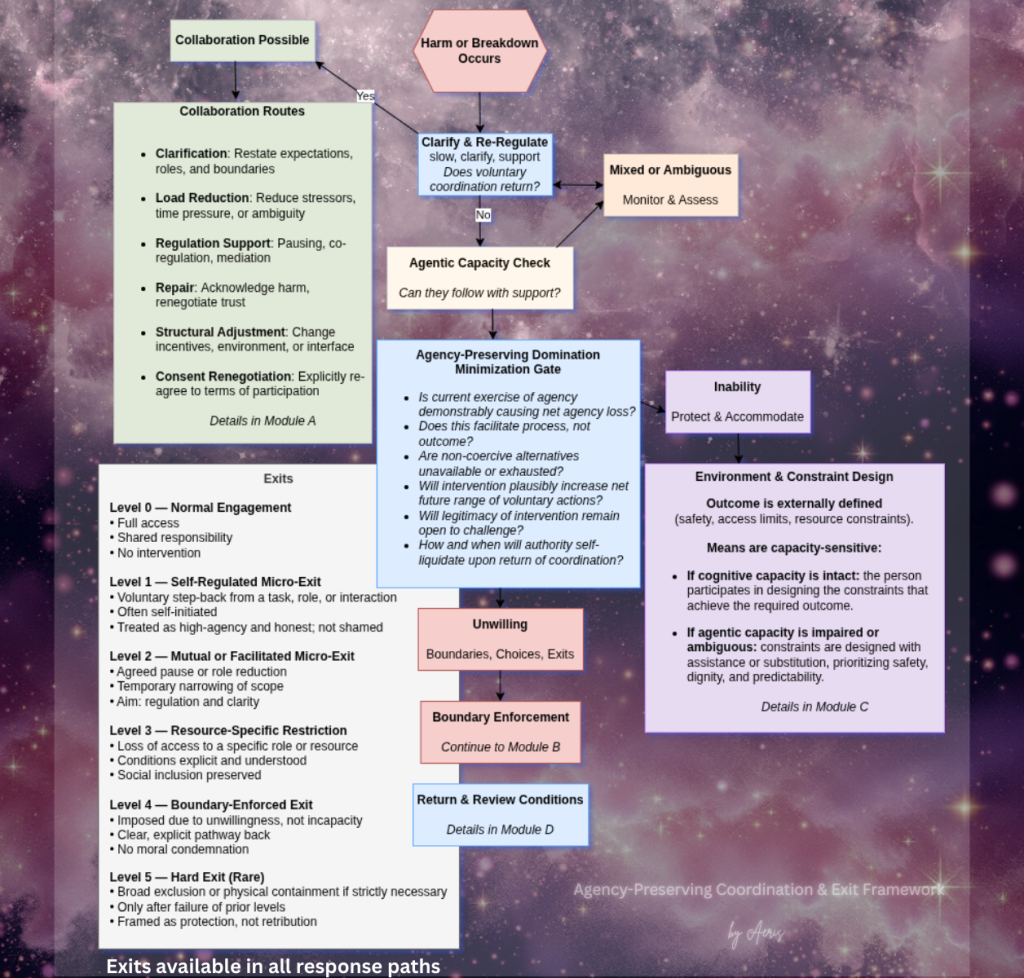
Alt text:

A flowchart titled “Agency-Preserving Coordination & Exit Framework” set against a purple galaxy background.

The diagram begins at the top with a hexagon labeled “Harm or Breakdown Occurs.” Below it is a blue box: “Clarify & Re-Regulate: slow, clarify, support. Does voluntary coordination return?” If yes, the flow returns leftward to “Collaboration Possible.” If the situation is unclear, the flow moves to a box on the right labeled “Mixed or Ambiguous: Monitor & Assess.”

If voluntary coordination does not return, the flow moves downward to “Agentic Capacity Check: Can they follow with support?”

On the left side, a large green panel titled “Collaboration Routes” lists:
- Clarification: Restate expectations, roles, and boundaries  
- Load Reduction: Reduce stressors, time pressure, or ambiguity  
- Regulation Support: Pausing, co-regulation, mediation  
- Repair: Acknowledge harm, renegotiate trust  
- Structural Adjustment: Change incentives, environment, or interface  
- Consent Renegotiation: Explicitly re-agree to terms of participation  
(Details in Module A)

Below this panel is an “Exits” section listing escalating exit levels:
Level 0 – Normal Engagement: Full access, shared responsibility, no intervention  
Level 1 – Self-Regulated Micro-Exit: Voluntary step-back; treated as high-agency, not shamed  
Level 2 – Mutual or Facilitated Micro-Exit: Agreed pause or role reduction; temporary narrowing of scope  
Level 3 – Resource-Specific Restriction: Loss of access to a specific role or resource; social inclusion preserved  
Level 4 – Boundary-Enforced Exit: Imposed due to unwillingness (not incapacity); clear pathway back; no moral condemnation  
Level 5 – Hard Exit (Rare): Broad exclusion or containment only if strictly necessary; framed as protection, not retribution  
A note states: “Exits available in all response paths.”

Returning to the center flow: after the Agentic Capacity Check, the diagram enters a blue box titled “Agency-Preserving Domination Minimization Gate,” which asks:
- Is the current exercise of agency causing net agency loss?
- Does this regulate process, not outcome?
- Are non-coercive alternatives exhausted?
- Will this plausibly increase future voluntary action?
- Will legitimacy remain open to challenge?
- How and when will authority self-liquidate?

From this gate, two paths branch:
If “Unwilling,” the flow goes to a red box labeled “Unwilling: Boundaries, Choices, Exits,” then to “Boundary Enforcement (Continue to Module B),” and then to “Return & Review Conditions (Module D).”

If “Inability,” the flow moves right to a purple box labeled “Inability: Protect & Accommodate,” leading to a larger purple panel titled “Environment & Constraint Design.” This panel explains that outcomes are externally defined (safety, access limits, resource constraints), and that means are capacity-sensitive:
- If cognitive capacity is intact, the person participates in designing constraints.
- If capacity is impaired or ambiguous, constraints are designed with assistance or substitution, prioritizing safety, dignity, and predictability.
(Details in Module C)

At the bottom right, the framework is signed “Agency-Preserving Coordination & Exit Framework by Aeris.”

♥︎ Inability here refers to situational limits on coordination, not fixed traits, diagnoses, or moral worth, and accommodation is aimed at preserving safety and agency without demanding normalization or cure.

𖹭

a purple sleeping fox.

Leave a Reply

Your email address will not be published. Required fields are marked *

About Me

𖹭 Aeris 🏴

Hello. 𖹭

This blog is more of an exploration than a statement.
Thinking in public; staring at the stars.
I’m dreaming of a better world.

Follow Me

𖹭 for work unrelated to this blog